
Belonging and the vagaries of feeling at home

“In contrast to how a child belongs in the world, adult belonging is never as natural, innocent, or playful. Adult belonging has to be chosen, received, and renewed. It is a lifetime’s work.” – John O’Donohue

“As you grow, you develop the ideal of where your true belonging could be – the place, the home, the partner, and the work. You seldom achieve all the elements of the ideal, but it travels with you as the criterion and standard of what true belonging could be.” – John O’Donohue

Where do I belong (?), Where is home (?), is a deep and ongoing search for many of us, and an ongoing discussion in our house these days. Who, What, and Where do I belong?   For those of us who have been uprooted and moved multiple times from our places of birth, and of childhood belonging, it becomes harder at times to define what home means. Where we feel most comfortable. Where we belong. Do we belong where our family is from? Is there even a place? Or is a feeling? Is it people? Is it where the heart is, as the cliché goes? Or are there many places and spaces that we can and do belong to, and call home?

I have vicariously traveled along with these past two weeks as my brother has taken his adopted young children back to visit their country of birth. Having not yet had the chance to speak with him about this I can only imagine from my own perspective what this may be like, the many differing emotions and thoughts that have arisen. Even in ones so young. And for the parents, how we all wish to provide stability and safety for our children. Have them feel completely at home within themselves, and within the home we hope to make for them.

My own children have recently moved continents and countries away from their own country of birth. A place they’ve called home. They all three have differing perspectives on what being at ‘home’ is. There is attachment to place, to people, to land, to friends, to family, to house. Sometimes home truly is where the heart is, where family is. But at other times the heart also needs a physical space, a physical space that says “this, this is where I belong”.

As a child growing up with a traveler’s life far from where I was born and where I had extended family, and having never really lived close until recently to my own historical family, I know this feeling all to well: the constant journey and search for belonging and being home. The paradoxical longing for the open road, for the adventure and excitement of new discoveries set against the yearning for a place to rest, to belong, to be known and unconditionally accepted.

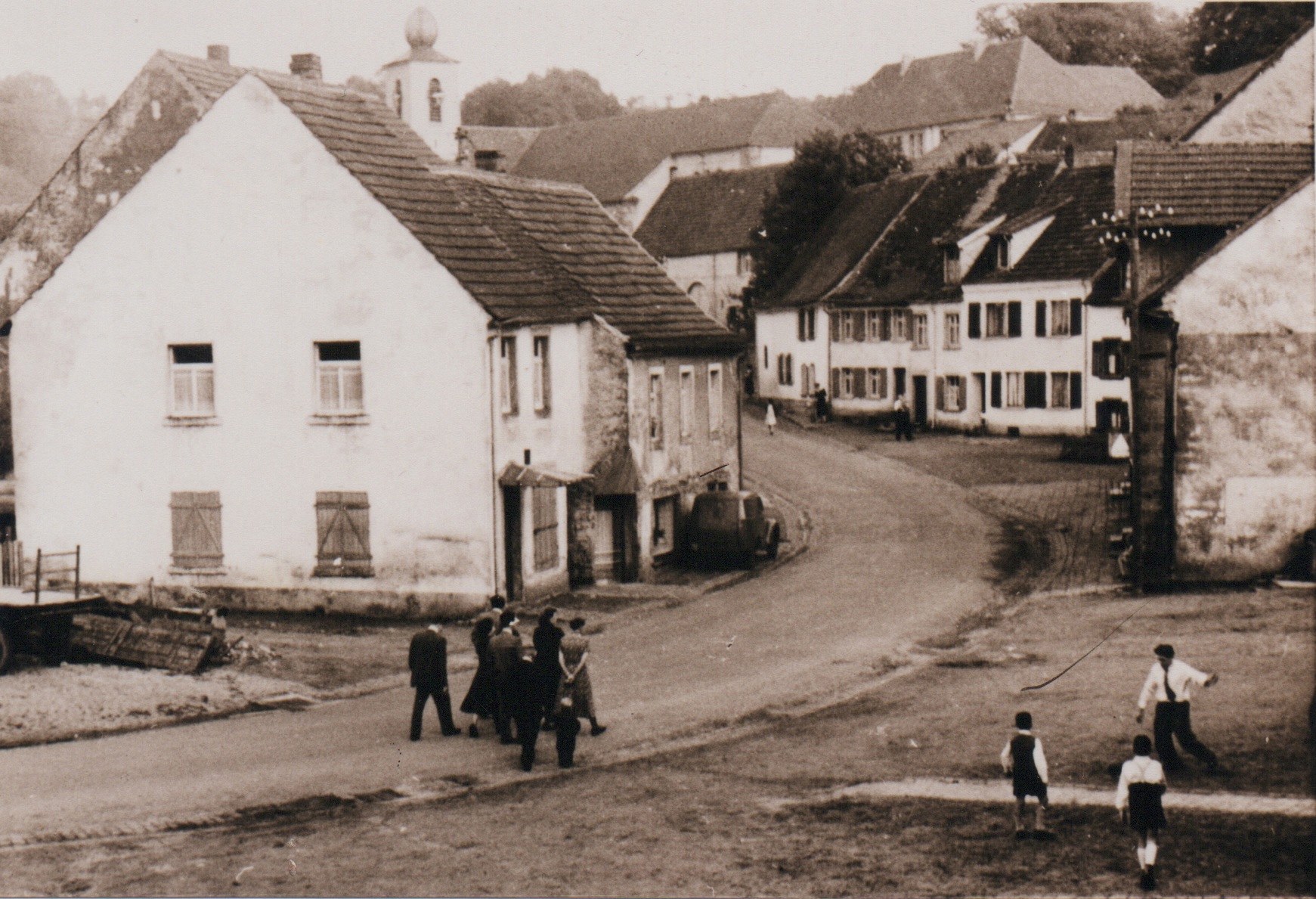
The recent sale by my cousin of my grandparent’s house in the small village where I was born has unexpectedly thrown this sense of searching for belonging, for home, and unconditional space of being, into stark relief again.

I have no memory of my grandfather who died when I was just 21 months but he lives very prominently through the stories my father has told. My grandmother I remember well, often found seated at her kitchen table, and whom I loved to greet first whenever we visited. I vividly recall the sensation and smells of rushing up the winding stone marble staircase, once the door had been buzzed open, entering at the ground level, past the basement where as a small child I remember the potato harvest was stored and the pig was housed through the year until slaughter time at year end, past the first floor with living rooms with coal furnace, kitchen, and my aunt’s and uncle’s bedroom to the top floor and the small apartment my grandmother inhabited. Somehow to see her smile and fold me in her arms felt like being home again. I loved nothing better than sharing her bedroom at night in the twin bed alongside hers snuggled under the overstuffed feather duvet while I watched her brush out her long grey hair; retie it in a plait for the night and which she wore in a bun through the day. The first thing I asked always on arriving was what task I could do for her and very soon without fail would be happily racing off to the store across the road to buy some buttermilk, content that I was ‘once again at home’. With her I always felt I was enough, no matter how I showed up, I suppose that is the essence of belonging, of feeling at home, and an unconditionality of being that is accepted with love and kindness. My grandmother, despite her complex nature, was for me the epitome of kindness and compassion. Now that the house is sold, and 600 years of family history in that house and village is let go of, it is harder to hold onto this innocent childhood “place of belonging, of home”, I wonder if it even is a place anymore, or only held as a childhood memory? Perhaps as John O’Donohue implies it is time to examine with new eyes the adult sense of belonging that continues as a lifelong journey and a lifetime’s work, and a story for another day.
 Scan 113
my ‘home’ village in the 1950’s

What does belonging and being home mean for you?

Posted in Life, stories & more | Tagged , , , , | Leave a comment

2014 The Engaging with a Wholeheart Project: June

Cultivating Intuition and Trusting Faith – letting go of the need for certainty

Thirty-seven years ago on the 7th day, of the 7th month, in the year 1977 my journey into greater uncertainty started. I still remember that day clearly. I was twelve years old. We were gathered at the local airport just up the hill from my small village in Germany, surrounded by family, about to embark on the long journey into the Far East. We had already been for many years the “Africans”, the part of the family that dared be different, that somehow felt comfort in traveling to strange and foreign lands to live, which for many at that time in our small family villages in Germany and France seemed unimaginable. That past summer I had spent with my cousin attending school, had many of her school friends ask if we lived in grass huts, rode elephants to school, and lions roamed freely in the streets. (Although not much may have changed… My own children tell me they have still had some of the same questions asked of them.) And so from having been “African” we were embarking on a journey to become “Korean”.

The long flight took us from Saarbrücken-Ensheim airport to Frankfurt to Fukuoka, Japan where we waited in a hotel for some days while visas and work permits were finalized. I remember lying awake one night with an aching arm, after having had the requisite Cholera vaccination, wondering about this strange journey we were on, feeling a mixture of anxiety, fear, loss, anticipation and excitement at what lay ahead. All made safer as I was with family, and my one brother who often helped me mediate the world in those early years. My young mind could not imagine what was coming our way. There were no television stories to tell us. The media and books I had found in Windhoek had been heavily anti anything from the so-called communist east. Searching the world map in our school geography book for Korea all I remember is it being a very small peninsula shown right next to the very large, completely coloured in communist red, country of China. All I had heard, from my young mind perspective, about this region was propaganda and fear. I had no idea how to think about this move other than it seemed a good move for my dad, exciting for our family, we were all going together, and the best was we could order from a company catalogue some special treats from Germany to supplement our local finds. The excitement when the packages arrived, and we could have some chocolate again, was like Christmas every time.

Arriving in Pusan, South Korea, it felt like I was rendered illiterate overnight. All the signs were in writing that I could not understand, and I had no idea what anyone was saying. Despite this everyone was friendly and curious. Perhaps from my perspective a little overly so. Everyone wanted to touch my hair and the concept of personal space seemed not to exist. We were touched, pulled along, embraced, especially us children. All with big smiles that we dare not deny. And after some time of living in the local neighborhood we were in we found ourselves getting used to the sounds and sights and smells and food, everything was different to anything I had ever experienced. There was no real preparation for this change, no thought to prepare for the adjusting, just an expectation that it could be done, that all would be fine. We were occupying the top floor of our landlord’s house, I was sharing a room and a bed with my younger sister, while my brothers got the big bedroom with beds and desks each, and my parents set up a bed in the lounge behind a screen. After a month of playing on the streets outside our glass encrusted walls, and playing ping pong with the boys downstairs whom we could not understand, we were enrolled in the only English school in town, on the US army base of Hialeah. Having left grade 7 in Windhoek after only two months of school, and being in Germany while my dad entrained into his new work, it was decided that we would be enrolled into the next grade. I started school again in grade 8 and never did do grade 7. Academically at the time it was not really a problem. The bigger issue for me was social. I was more than a year younger than most in my class. This may have not been necessarily important but as I found myself new to the school, to this third culture of Americanisms, and on the cusp of puberty, the division was between being able to go to the teen section of the after school teen club, as opposed to the pre-teen section. All the kids in my class could go to teen section. As a newbie I could only get into the pre-teen section. Don’t get me wrong I made some amazing friends who were in grade 7, and they were some of my closest friends in Pusan(now Busan) and we are still in touch, but it was not a good start for building confidence in my teenage self when I was having to learn to adapt to a completely new culture and then quickly adapt to a third system in going to an American Army Base school.

All the other kids seemed more confident and outgoing and even though I was pretty good at being that too, even if quietly so, it was at an internal cost that only showed up years later when things unraveled at university, and I could no longer bluff my way through, and the academics did not keep up. And as the years have gone on the need for certainty at times has grown. Has sprouted into a need for being organised, perfect, and always in the know. In time all that too has come apart and now it is time to let go of needing to know. Needing to be certain. Time to trust my own senses and intuition and listen to my deeper longings with faith that this is the simpler and truer way to show up for my life.

photo(1)

Yesterday another 7 day of importance passed. 7 + 7 = 14, 7 x 7 = 49, the end of my own 49th year, and the beginning of the mid-century. Can’t quite believe where the time has gone. It does however feel like all the turmoil of change and adaption, hiding and masks, restriction and growth, has come full circle, and that for the first time in a very long time I am residing in a place of my own choosing, one that I have actively sought out and despite all the difficulties have stayed the road and find in that less need for certainty, and even less need for complete clarity, less need to know what will be around the next corner. There is a capacity to trust and have faith that this will all be okay, now and in time. And what stays constant for me is the turning toward the uncertainty, turning toward the difficult, turning toward the faith that in this moment everything is truly okay and in that there is much to be grateful for.

In all of this I have finally come to have a deeper appreciation of one of my favorite Haiku’s by Basho

My house burnt down

Now I can see the other side

Posted in 2014 Engaging with Wholeheart Project | Tagged , , , , , , , | Leave a comment

2014 The Engaging with a Wholeheart Project: May

Cultivating Gratitude and Joy – Letting go of Scarcity and Fear of the Dark

“Wanting a soul life without the dark, ………is like expecting an egg without the brooding heat of the mother hen.”

© David Whyte from The Heart aroused

My family knows I am the easiest person in the world to scare. Just say ‘boo’ and I jump. Even if I know it’s coming, I still get a fright. Just the way my nervous system has been programmed over the years. Such fun for everyone to test on occasion, especially my children, almost like a party trick that they can roll out when they are bored, until they realise that I really do get a fright, and are moved at times by a sense of compassion for my disrupted nervous system. It is the unpredictable that has scared me, the jumping out from behind doors, the dark, the not knowing. Now, however, that seems to be slowly changing. Seems to be attaining a status of resolving residual nervous system operating system. To support my thought that this is just some residual habit of my nervous system I have been surprised lately to find that walking around my new city at night brings up none of these old fears. It seems the years of being fearful of walking through the dark and living in the valley of shadows may be over. It may be time to cultivate gratitude and joy. Time to let the light in.

night

Perhaps, before I continue, an apology. This post is late. More than two weeks late in fact. In starting with this project this year I had committed to posting on a Wholeheart topic every month around the 14th day of each month. Now it is the next month already. And other blog posts have also not been easily forthcoming. There has been difficulty in writing. An understatement. The committing to write from the heart has at times meant crossing into personal and intimate journeys that are not comfortable sharing spaces.  Being vulnerable in full view is another step in the unfolding journey. But having committed to this writing, this project from a perspective of wholeheartedness and vulnerability, to be less than that is not really possible with these offerings to contemplate.  Why then this is late. And short.  And still not so very personal.

My journey this past year has been one of opening to my deeper truth, the longing for the light, the light that has been patiently waiting. To the being honest with those around me, to allow in the rawness and the meeting of the pain, and the eventual capacity to let go, to loosen the clinging and allow an interior orientation that is more flexible, relaxed and at ease with how things are.  With acceptance comes the paradox of joy, of gratitude, of connection, of being encountered with at the very real raw level of our intimate humanity. That is the longing we all have.

For longing – John O Donohue

Blessed be the longing that brought you here

And quickens your soul with wonder.

May you have the courage to listen to the voice of desire

That disturbs you when you have settled for something safe.

May you have the wisdom to enter generously into your own unease

To discover the new direction your longing wants you to take.

May the forms of your belonging–in love, creativity, and friendship–

Be equal to the grandeur and the call of your soul.

May the one you long for long for you.

May your dreams gradually reveal the destination of your desire.

May a secret Providence guide your thought and nurture your feeling.

May your mind inhabit your life with the sureness with which

your body inhabits the world.

May your heart never be haunted by ghost-structures of old damage.

May you come to accept your longing as divine urgency.

May you know the urgency with which God longs for you.

So as I write this month, so long overdue, while I fly over that majestic continent of Africa to bring this journey full circle, cultivating gratitude and joy even as I share some of this journey with you, I am very intimately aware of how much I have to be grateful for and how much joy there is in my life. And that it comes not from blithely or blindly stepping into an unknowable desire but into the unknown longing that draws all of us closer to the source of our own hearts and healing and strength. A turning toward the difficult, a looking deeply into the abyss, and knowing that I have finally found my way out, that no other is responsible for this journey, even as I am still deeply responsible and tied to the lives of those around me.

Though this may be sparse with the story and the detail, with that rational cognitive part with which you can make sense of these reflections, none of that is of any import. What is relevant is that in the turning toward a greatest fear, a fear of the dark, of being alone and abandoned, and in trusting this journey of longing for a deeper knowing and truth, a journey not always understood but one that has drawn me ever onward, I have found than listening to that soft voice that is my own, in amongst the many clamoring for airtime, is the only way to set the compass of my own heading, of my heart, of this journey I call my life.

What is it that you listen for? That you trust even as you don’t fully understand? And in so doing cultivate a grateful and joyful heart that can lead you out of the darkness.

May you all be well, this day, a day to fill with gratitude and joy for all that is and may you come to understand and accept your longings as divine urgency.


Posted in 2014 Engaging with Wholeheart Project | Tagged , , , , , , , , , , , , , , | Leave a comment

2014 The Engaging with a Wholeheart Project: April

Cultivating a Resilient Spirit – letting go of numbing and powerlessness

When considering what resilience means for me I often return to the subject of vulnerability and how being truly resilient and knowing the depth of one’s strength and personal capacity and power, one must also know the shadow sides, the depth of one’s vulnerabilities and be willing to show them and show up for them.

Resilience is the capacity to be okay with whatever shows up, and whatever comes one’s way. For that to happen there needs be a sense of self that lends one the capacity to bend rather than break. Resilience confers that capacity to face all our challenging parts. Even the parts we have disowned, that cause us to doubt ourselves, that we may feel render us weak and unlovable, or unprofessional or whatever un-definition one would like to name. The parts, that if we choose to believe their stories, render us powerless to connect with the present that we are engaging with and then indeed have any impact on our future. That is the connection of powerlessness to resiliency. Only once we recognise that our vulnerability is our strength does the fear of weakness no longer scare and frighten us and we can begin to consider letting go of the fear of being afraid itself. In so doing we stop living within the vortex of powerlessness and turn toward embodying a more resilient spirit.

As a small illustrative example, I recently got myself lost on purpose.  A new experience for me.  The GPS refusing to recognise the address I needed. I knew the suburb it was insisting on giving me was nearby so I decided to go there anyway and see, but of course the office block that it took me to was not the house I was looking for. In getting closer to my target, however, the GPS suddenly could recognise where I wanted to go. In the past I might have panicked or been completely frustrated by this, but I found myself willing to be lost, sort of.., willing to experience the emotion of not quite knowing if I was going in the right direction, and in so doing found myself closer to where I needed to be than I had imagined. Letting go of the fear of feeling fear, letting go of the fear of being out of control, I found myself able to be so much more creative.

As this year of living wholehearted unfolds I find myself ever more willing to just show up as I am. To not constantly offer explanations for my life, for this journey that I find myself on. At times this can be discomforting, especially if those questioning are more used to neat answers. I find myself no longer unwilling to comply, to pretend life is anything but what it is, messy and complicated and beautiful and wondrous. I know I am blessed. I have chosen to step off the beaten path and am still supported in that. I have chosen a life of uncertainty for now and stopped the numbing, and have no real idea what the future holds. Rather than that have me feel fear and powerless I feel anything is possible.

Having not written this blog for a while, being busy with family, traveling and more, I find myself returning to my intention for this year: to write, speak and be from the heart; to deeply reside in that space that no longer is willing to give in to numbing and masking and hiding; to listen deeply within myself and not give in to easy answers but to stay, sit, wait, be, breath, and allow the world to find me. May you give in to that which is already present and be more wiling to bend with it. May your resilient spirit continue to grow through this engagement.

2014-04-10 15.39.49

A BLESSING

May you be blessed in the Holy Names of those who carry

our pain up the mountain of transfiguration.

May you know tender shelter and healing blessing when

you are called to stand in the place of pain.

May the places of darkness within you be turned towards the light.

May you be granted the wisdom to avoid false resistance

and when suffering knocks on the door of your life,

may you be able to glimpse its hidden gift.

May you be able to see the fruits of suffering.

May memory bless and shelter you with the hard-earned

light of past travail, may this give you confidence and trust.

May a window of light always surprise you.

May the grace of transfiguration heal your wounds.

May you know that even though the storm might rage yet

not a hair of your head will be harmed.

John O’Donahue


Posted in 2014 Engaging with Wholeheart Project | Tagged , , , , , , , , | Leave a comment

Mindfulness – our sixth sense: series conclusion

Over the last ten weeks Dr Patricia (Trish) Lück, a palliative care physician and facilitator of mindfulness-based stress reduction (MBSR) programmes has been writing a weekly series on Mindfulness and how engaging with this particular process may benefit many areas of our lives as hospice and palliative care workers.

In fact, it may even change our lives completely.One of my favourite insects is a dung beetle and this is a photo I use in my presentations all the time. As you may know, the dung beetle is a scarab, a beetle of great significance, which is associated with funeral rituals in ancient Egypt. It is a powerful symbol of transformation and renewal, a reminder that in all endings reside the seeds of new beginnings.

This is the journey of the African Dung Beetle, a beetle that finds unlikely nurturing and growth in elephant dung; that which has been discarded.

It is in the dung that the beetle lays its eggs and nurtures the young. For me this is a reminder of many things: of persevering in the face of the daily difficult; of continuing to dream and transform oneself no matter how challenging the present moments may be. It also for me somehow has come to symbolise the work I do, that all of us in this territory of life-limiting and life-threatening illness engage in, work that many may shy away from and do not want to discuss: the frontier territory of death, distress, difficult news, and dying.

The dung beetle reminds us perhaps how no matter how difficult every situation may seem; there is a possibility for some joy or new discovery that may grow out of it. It is my experience that becoming aware of what is present for me, for my patients, within my environment and being able to be present for this without judgement, premature assessment or needing to drive a particular outcome, with kindness, patience, and open curiosity, allows a turning toward a particular way of engaging with this moment that allows an environment of caring, listening and healing despite the possibility that this may be the most difficult and challenging moment yet to be engaged with.

Over the past ten weeks, this series has covered some of the themes that are traditionally explored in an eight-week MBSR programme, paying particular attention to the needs of the palliative care community.

If this series has piqued your interest in attending an eight week mindfulness based stress reduction program or similar mindfulness based intervention, you may well find one in your home town or country. Hopefully the ending of this series is only beginning of your own journey into greater presence, care and kindness for this one precious life we have.

Kindness

Naomi Shihab Nye

Before you know what kindness really is, you must lose things, feel the future dissolve in a moment like salt in a weakened broth.

What you held in your hand, what you counted and carefully saved, all this must go so you know how desolate the landscape can be between the regions of kindness. How you ride and ride, thinking the bus will never stop. The passengers eating maize and chicken will stare out the window forever.

Before you learn the tender gravity of kindness, you must travel where the Indian in a white poncho lies dead by the side of the road. You must see how this could be you. How he too was someone who journeyed through the night with plans and the simple breath that kept him alive.

Before you know kindness as the deepest thing inside, you must know sorrow as the other deepest thing. You must wake up with sorrow. You must speak to it till your voice catches the thread of all sorrows and you see the size of the cloth.

Then it is only kindness that makes sense any more. Only kindness that ties your shoes and sends you out into the day to mail letters and purchase bread. Only kindness that raises its head from the crowd of the world to say: ‘it is I you have been looking for’, and then goes with you everywhere like a shadow or a friend.

The Center for Mindfulness 2014 Annual Conference

Massachusetts, USA, 2 to 6 April 2014
Dr Patricia Lück will be attending the annual scientific conference of The Center for Mindfulness, presenting a keynote talk on mindfulness and palliative medicine in South Africa.

All keynotes as well as the Kluge Research Symposium will be streamed live during the conference. Visit the conference website for further information.

Posted in ehospice: Mindfulness - our sixth sense | Tagged , , , , , , | Leave a comment

Mindfulness – our sixth sense: self-care begins here (ehospice series)


Today is the ninth week of our ten week mindfulness series by Dr Patricia (Trish) Lück, a palliative care physician and facilitator of mindfulness-based stress reduction (MBSR) programmes, exploring self-care for the healthcare professional in everyday palliative care moments.


Many, if not all, of us struggle with caring for ourselves. This seems to be a common affliction, and especially so for health care professionals caring for the most vulnerable in our society. It seems to be a paradox that we need to first care for ourselves well before we are able to care better for others. Indeed being of service can be a healing part of our day and give great meaning to our lives. In giving we often find that we receive so much more. If, however, the giving and being of service goes beyond the boundaries of our own capacity without us being fully aware of this, we are in danger of becoming run down, suffering compassion fatigue and burnout and even not being able to manage our day to day interactions.

It is telling that this is an issue even for me, despite the fact that I have widely lectured and given workshops on precisely this topic. I was struck recently in conversation with my daughter that after so many years of doing the traditional required amount of children’s ‘bee’ projects, I never really considered that the bee was not just playing a role in collecting nectar for the hive and in making the honey, but that the bee needed to feed itself along the way first to sustain its own energy capacities. It felt like a light bulb moment: so very simple, but one I had consistently missed for many years.

Self-care can be as simple as taking a few more purposeful moments in the day to eat, drink, walk, sit, hold conversation, listen deeply, exercise, wash and sleep with greater awareness. Taking time to be with the tasks that need doing each day in the small things we already do that take care of our bodies, minds, work spaces and families. The capacity to allow mindful awareness to arise within the moments of our day enables our capacity to connect with what is needed now and not to be stuck in an automatic mode of ‘just carrying on’ no matter the need. The capacity to stop, take a few breaths, a few moments, to reflect and observe what is happening and then proceed can be a valuable pause inserted into the unfolding of each day.

Michael Kearney, in his excellent article on self-care of physicians at the end of life, identifies some simple measures that could be protective against burnout. These include mindful meditation, reflective writing, supervision and mentoring, sustainable workload, promoting feelings of choice and control (as discussed in last week’s article), a supportive work community, fostering communication and self-awareness skills, practicing self-care and mindfulness based stress reduction for team.

For me it begins with becoming aware of how we care for ourselves already each day and pay a little more attention to that – and especially how we communicate with ourselves and others, how much kindness we bring into each day. Peirro Ferrucci in his book: The power of kindness states that: “Attention is the medium through which kindness can flow. No attention, no kindness. And also no warmth, no intimacy, no relationship.” Attending to ourselves with kindness, love and care can be the greatest gift we offer those we attend to in our daily lives. Mindfulness can be a radical act of love and kindness in and of itself. Being with whatever arises in this moment, without judging how it should be – or how we should be –with heart and with warmth and with kindness, is a moment of self-care purely through the simple act of showing up for our lives with kindness and care.

Finally, I wish to remind ourselves that we can find self-care and meaning and vision in the very presence of our daily work. Often we neglect that this can be a source of self-care in and of itself, that it is what we have chosen to pursue each day and to continue to engage with every day. As Rachel Remen, doctor, healer and author, states: “No question that the medical system (in the USA) is seriously broken, but Medicine itself is not. Even on the most stressful and pressured of days there are moments in which we can experience something else, moments in which we connect to people on a very intimate level and make a difference to them and they to us. Times when, despite everything, we experience compassion, give and receive love, ease suffering and fear and are profoundly trusted. Instances when the greatness and courage of an ordinary person is suddenly revealed and we know ourselves to be in the presence of a hero. Or we recognize that we ourselves are heroes. No question that these experiences are brief, but they happen daily. And often they are life-giving – like taking single breathes of pure oxygen in the middle of a deep-water dive. There is a deep river of meaning that runs through the work of every health professional. It can sustain us in difficult times.”

So as you continue into the next week, take some time to sit, breathe, walk, be, and allow – in those moments of connection and reflection and mindfulness – to be fully present to the magnificence of your life. Take some time to STOP, engage in mindful meditation and reflective writing and engage with kindness and care with yourself, your patients and your own families.

STOP exercise

S – Stop

T – Take a breath

O – Observe, pause, take a few moments to consider what is happening now. What are you feeling, thinking, what sensations are present. What is needed now.

P – Proceed with full awareness and no longer with the automaticity of the habitual mind but with the capacity to respond with awareness of knowing this moment fully.

References

Kearney, M.K., Weininger, R.B, Vachon, M.L.S. et al. Self-care of Physicians Caring for Patients at the End of Life: “Being Connected … A Key to My Survival” JAMA. 2009; 301(11). pp:1155-1164

Posted in ehospice: Mindfulness - our sixth sense | Tagged , , , , , , , , , | Leave a comment

2014 The Engaging with a Wholeheart Project: March

cultivating self-compassion – letting go of perfection

IMG_6546

One of my personal themes often  is that of trying to please many.  To not easily sit with the discomfort that arises when I and people around me are sad, mad, and generally unhappy.  Trying to change how these moments unfold.  A deeply rooted narrative that in time with deep listening, compassion and awareness allows me more to stay with discomfort that arises when I can’t please everyone, or even myself.  Sometimes I forget though and try to do too many things at once, and like last night, while tired from traveling, scalded my hand with hot pasta water.  All fine there today but in the spirit of cultivating self-compassion and letting go of perfection, declaring some time to pause and rest, even as this post is due on this self imposed deadline of the 14th of the month, this will be an imperfectly delivered post.  A very short one.  But I will share a poem.

May you next month be one of staying close to yourself.  Leaning into the discomfort of not being perfect, and cultivating kindness and compassion for your being that strives to have each moment be different, or indeed – be perfect.  May we all learn to live with a little less perfection and cultivate wholeheartedness in just being, however that may show up.

Sweet Darkness by David Whyte

When your eyes are tired
the world it tired also.
 
When your vision has gone
no part of the world can find you.
 
Time to go into the dark
where the night has eyes
to recognize its own.
 
There you can be sure
you are not beyond love.
 
The dark will be your womb
tonight.
 
The night will give you a horizon
further than you can see.
 
You must learn one thing.
The world was made to be free in.
 
Give up all the other worlds
except the one to which you belong.
 
Sometimes it takes darkness and the sweet
confinement of your aloneness
to learn
 
anything or anyone
that does not bring you alive
 

is too small for you.

Posted in 2014 Engaging with Wholeheart Project | Tagged , , , , , , | 1 Comment

Mindfulness – our sixth sense: impermanence and resilience

Today is the eighth week of our ten week mindfulness series by Dr Patricia (Trish) Lück, a palliative care physician and facilitator of mindfulness-based stress reduction (MBSR) programmes, exploring impermanence and resilience in everyday palliative care moments.

Life is anything but permanent, as many of us who work in the area of life-threatening illness and dying know, and it demands of us that we show up with compassion and resilience for our everyday encounters. My understanding of resilience includes the capacity to be present and to feel okay with what arises for us every moment of each day, and to meet it with flexibility of spirit and response. This capacity of resilience can be cultivated to enable us to meet life in all its complexity.

I have spent the past nine days at a small retreat centre at the base of a mountain in the southern Drakensberg Mountain Range in South Africa. This particular mountain is revered as sacred in both San and Zulu traditions for its capacity to bring forth rain. Cave paintings depict the San elders performing rain-making ceremonies. Zulu rituals to pray for rain take place at its base in times of scarcity.

During the nine days I sat in retreat, we did not suffer from a lack of rain and at times it was hard to believe that there was even a majestic mountain behind the curtain of mist, rain and cloud. But the mountain did appear at times and the last two days it shone with clarity against a deep blue sky between torrential downpours, only to be swallowed up again by the mist as we drove away. What I intimately learnt from sitting under this mountain during the weather patterns that swirled around it as well as through my heart-body-mind-space, was a deep knowing and a felt sense for how impermanent the weather patterns of our personal as well as our physical environments are.

The capacity to be with what presents itself in our heart-body-mind-space, like weather swirling around a steady ever-present mountain, helps us to understand how a greater capacity for mindfulness can impact how resilient we feel in our day, our life, and our work. How we perceive and understand events, or for that matter, fail to perceive or understand them, often determines how we respond to them.

Most of us have an understanding that we have little control over external events, such as the weather, but have some capacity to determine how we respond to them. In 1979, Suzanne Kobasa looked at how personal dispositional factors influenced whether we interpret a stressful event as threatening or not. She described three psychological aspects: control – whether we feel we can impact some areas of our lives positively; commitment – how engaged we feel with our daily lives; and challenge – how much we feel we can effect change on our life circumstances. She related these factors to ‘Stress Hardiness’, which is understood more and more as an important factor in psychological resilience, our capacity to be resilient even in the face of great challenge.

Our growing capacity to be with all our moments as they arise, with patience and kindness, supports our capacity for presence, for resilience, for being mindfully engaged in every moment. A capacity to be able to engage with the positive moments that arise in our lives, to be engaged with what we are doing, and to see the difficulties that may arise as challenges rather than problems. The simple exercises: staying with your breath, body scan, eating, walking with mindful presence, can be supportive of engaging with a capacity to recognise each moment as it arises and even in the face of impermanence, illness and death, to be stress hardy and resilient.

References

Stressful life events, personality, and health: An inquiry into hardiness. Kobasa, Suzanne C.  Journal of Personality and Social Psychology, Vol 37(1), Jan 1979, 1-11. doi: 10.1037/0022-3514.37.1.1

Posted in ehospice: Mindfulness - our sixth sense | Tagged , , , , , , , , | Leave a comment

Mindfulness – our sixth sense: communication and working with difficulty

05 March 2014


This week, week seven, in our ten week mindfulness series by Dr Patricia (Trish) Lück, a palliative care physician and facilitator of mindfulness-based stress reduction (MBSR) programmes, we explore the theme of communication and working with difficulty.


This week, the theme is: ‘Communication’ – how we communicate with one another as well as how we communicate with ourselves.

During the course of this session the often complex and complicated area of communication can be engaged through use of different methods and tools. Some facilitators use the approach taught by Jon Kabat-Zinn and Saki Santorelli which is based on Aikido, a martial arts discipline that, when engaged with as a communication approach, embodies how we interface with ourselves, with our world and with those around us, and demands of us to notice our habitual and often unaware and unconscious communication patterns. This approach asks us to turn into and toward all that communicates with us, whether easy or difficult, stressful or not. I will be sharing more of how this approach has informed my own work within palliative medicine at the upcoming 12th Annual International Scientific Conference hosted by the Center for Mindfulness in Medicine, Health care, and Society at the University of Massachusetts Medical School.

Other facilitators share the work of Greg Kramer and his interpersonal meditative practice of Insight Dialogue. This interpersonal communication practice involves a deep listening to self and other, pausing, relaxing into what is here, opening up to what arises, trusting what emerges, listening deeply and then kindly and gently speaking one’s truth without any need to foreshadow the outcome. In our rush to talk, we often fail to communicate. In our rush to present our point of view, we risk shutting down that of the other. As healthcare professionals working in the most difficult of spaces with the very real suffering of people at their most vulnerable and raw, we are well served by a mindful capacity to listen deeply to what needs to emerge. It is especially important to allow time and space for the needs and questions that may not yet be known to emerge and to trust that these can be heard and gently spoken to.

In one of the very last teaching rounds I held before leaving South Africa, I was brought to visit a child with very difficult pain in one of the hospital wards. As often happened on these teaching rounds, we were a relatively large mass of people– doctors, nurse, social worker, students– all crowding into the room enquiring of the doctor there how she was addressing the patient’s pain. What may have been easily observable but also easily missed were the defensiveness and discomfort of the attending doctor on the ward. My practice of Insight Dialogue in action served me well and turned this situation from one in which much discord could have resulted with the needs of the patient not fully addressed, to one in which everyone’s attention  turned toward ‘what was needed now’ and ‘how could we best serve this patient’.

The practice of pausing, observing the communication that was happening in terms of verbal and non-verbal cues, relaxing into what was being felt by the individuals and the group, opening up to my own ambivalence and enquiring nonjudgmentally of the doctor about her own thoughts, and trusting what emerged through this interface.

Without this deep listening, we might have missed that this doctor was a specialist in her own right from a foreign country, not recognised yet as one in this country where she was working. Her own resentment and ambivalence at not being trusted with care became part of what was present in speaking her truth. We were able to agree on a plan of action that worked even with the possible misunderstandings of care that existed, and were able to ensure that this patient died a peace-filled, pain-free death very shortly thereafter. All this was achieved through the simple capacity of turning toward the communication difficulty rather than away from it.

So as you go through this next week, in addition to continuing to attend mindfully to breathing, eating, sitting, walking, daily tasks, perhaps spend some time noticing how you communicate with others, and how you communicate with yourself. Communicating not just through verbal interaction, but also through body language, writing, texting, and how you present yourself in public and private spaces, inwardly and outwardly. Noticing if you rush to communicate what is uppermost on your mind or if you can perhaps pause, relax, open to what is here, listen deeply first and then only speak your truth that emerges for this very moment. Try it. Remain curious of what this way of communicating may present for you. As you do so I will be in the middle of a nine-day silent retreat, not communicating other than with myself silently alongside others, and wondering how you are in the midst of this moment.

Posted in ehospice: Mindfulness - our sixth sense | Tagged , , , | 2 Comments

Mindfulness – our sixth sense: choices and commitment

This week, week six in our ten week mindfulness series by Dr Patricia (Trish) Lück, a palliative care physician and facilitator of mindfulness-based stress reduction (MBSR) programmes, we explore the theme of choices and commitment.

Having now come to week six of ten in this ehospice.com series I am curious, if you have followed the previous five weeks, how you have been working with the various options of choice and commitment. Being mindful, attending to the moments of the day with kindness, curiosity, patience, with a perhaps greater acceptance of what is already here, without needing these moments to change, be different, or forcing a desired outcome, opens up potential space for choice.

This is a space that can be stepped into with attention and skill, with a flexibility that acknowledges all the possibilities laid out. With cultivating mindful, curious, kind attention and care through the practice of the various meditations – eating, sitting, bodyscan, walking, as well as noticing the labels we attach to what we perceive as being pleasant or unpleasant events with the accompanying unfolding sensations, emotions, and thoughts that may occupy our mind body space – we are presented with some awareness that the moment opens up capacity for choice, capacity to make a decision in how to proceed, capacity to make a commitment to action or inaction.

As Goethe tells us, commitment takes boldness and boldness has genius, power and magic in it. It is not until we completely commit to a particular path that we let go of the ‘what ifs’ and ‘should haves’.

As Robert Frost melancholically rues in his poem: The Road Not Taken

Two roads diverged in a yellow wood,
And sorry I could not travel both
And be one traveler, long I stood
And looked down one as far as I could
To where it bent in the undergrowth;

Then took the other, as just as fair,
And having perhaps the better claim,
Because it was grassy and wanted wear;
Though as for that the passing there
Had worn them really about the same.

And both that morning equally lay
In leaves not step had trodden black.
Oh, I kept the first for another day!
Yet knowing how way leads on to way.
I doubted if I should ever come back.

I shall be telling this with a sigh
Somewhere ages and ages hence:
Two roads diverged in a wood, and I –
I took the one less traveled by,
And that has made all the difference.

How we make choices has much to do with our capacity to stay with ambivalence. Ambivalence by its very nature makes us uncomfortable. We would like to know and be sure. But ambivalence is the inherent nature of illness, of suffering, of death. Ambivalence is the constant bedfellow of our work with those that walk this path every day. And in that ambivalence, our capacity to make choices in the face of not knowing may become our greatest resource. And that action may be the choice to do nothing, to just sit and be present, fully present.

Last evening my own teenage daughter, given a difficult decision she needs to make, confessed how she struggles with such decisions and spends so much time once the decision has been made wondering about the other and whether she had made the right one. I don’t think she is alone in this angst. Ultimately the road we take is the one that makes the difference and determines the path we tread, as we cannot know what it would have been to take the other. At times, however, we find ourselves spending an inordinate amount of time wondering about the other road and maybe missing the actual road that we are on. Mindful capacity allows us to turn to the experience of this moment and let go of the moments of the past, the future or the ‘might have beens’.

So this week as you continue with the meditation exercises, continue to work with pleasant and unpleasant moments. Spend time eating, breathing, sitting, walking with mindful attention and notice the choices you are making. Notice if you slide into habitual reactivity and action or to being or not being, or if you can be aware in this moment of what arises, give it some moments of kind mindful attention, notice what arises in your fieldscape of sensations, emotions and thoughts, and then proceed with boldness and choice. Perhaps asking yourself a simple question: “What is called for now?”

Posted in ehospice: Mindfulness - our sixth sense | Tagged , , , , , , | Leave a comment